Scripture Readings: Is. 19:1-11; Gal. 2:1-10; Mk. 12:35-44
Ընթերցուածքներ` Եսայ. ԺԹ 1-11; Գաղ. Բ 1-10; Մկ. ԺԲ 35-44
In the Name of the Father, Son and Holy Spirit, Amen!

How would we describe an apple? Some of us would speak about its color, while others will describe its shape, perhaps the taste, feel and smell. How would we describe it in a different language, such as in Armenian? Would we say “the round apple is red?” or “the red apple is round?” Perhaps we think the differences are so tiny that they have no real consequence. Afterall, we are all, regardless of the language, describing the same apple. We are speaking about the same fruit – an apple is an apple! However, my dear brothers and sisters, while perhaps the description of an apple is not life-changing, what about more important matters, such as our faith? Yesterday, the Armenian Church remembered among its feasts the Feast of the Holy Translators -Սրբոց Թարգմանչաց. Many of us would define our saintly translators like St. Mesrob Mashtots, St. Sahak Partev, and many others as those who created, or developed the Armenian language and translated the Holy Scriptures among a plethora of other literature, thus making Christianity available in the common tongue of the people. Yet, that is not only what a translator does.

The word “translator”, as we use in the English language comes from the Latin words trans – meaning “across” and lātum, the past participle of ferre, or ferry meaning “to carry”. Therefore, a translator is someone who carries across, who ferries a person over from darkness and ignorance to knowledge and wisdom. Another word for this in the Church we use is illuminates, to enlighten, bring to light. Therefore, our Holy Translators are not merely those who changed the words of a language or who poetically spoke about faith and God. Rather, they are Holy Translators because they helped carry the Armenian people across, they helped all people, by ferrying them across the darkness of ignorance into the Divine light of God. That is why they are Holy Translators and not merely translators. They did not describe the proverbial “apple” but revealed to those who desired to learn about the creator of the apple, the purpose, the nutrition found within and benefit of indulging in all the blessings of what God has provided. This is all poetic and beautiful but what about us?
What kind of “translators” are we? We might say, we aren’t. Yet, each one of us in our own capacity, through our choices, by our words and actions are describing, and illuminating people to who God is. Parents are the translators of faith to their children, teachers to their students, a priest to his congregation, a lawyer to his clients, a doctor to her patients, a pedestrian to those he or she passes in the street, a driver to those who drive by or to the beggars who approach our windows asking for charity. And let us not forget, what about all our friends and acquaintances on social media? What kind of comments and interaction do they see? How we behave “translates” who we are and what we believe of God to others. Both on Instagram and Facebook, I’m not sure how many of us pay attention but when we like, dislike, or react to a post, others who know us can see how we react. A few weeks ago, I had commented on a random post and a friend of mine messaged me and said while they agreed with me, they were surprised I would even engage in the conversation online. I was surprised that my comment on a random trivial post, was seen by someone who knew me.

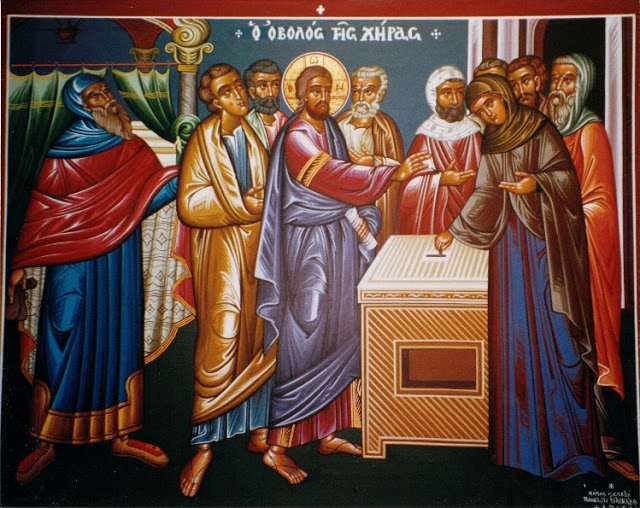
My dears, we are translating, while we are sitting here in Church or openly claiming with our lips we are a Christian, out those doors we are describing to the world who we are and what we believe. In the Gospel today, Christ rebukes the Pharisees who are teachers or translators of the Mosaic Law to the Jewish people; they are the ones who are supposed to continue the work of Moses and the Prophets, who carried the Israelites through the desert in preparation for the Messiah. Yet, Christ Jesus denounces them for their falsity, and rather, gives to us an example of the poor widow’s offering. We all know this story very well and we often speak about how what it describes not Gods desire for grandeur but sincerity. The widows 2 pennies are worth more than all the riches of the others who gave out of abundance. Yet, there is another layer my dear brothers and sisters.
Perhaps we all give sincerely; there is no judgement or condemnation. But when we do so, are we aware that the world watches us. Sometimes we see these video clips of people giving out money or buying thousands of dollars worth of food to give to the homeless. Personally, while yes the philanthropy they are doing is good yet, I am not a fan of posting these actions online. In fact, Christ tells us in the Sermon on the Mount, in the Gospel of Matthew, and several other places that when we do good, we should not be seeking the praise of people. And yet, people do see us; people watch. The widow gave her all, not expecting that 2000 years later we would be reading about her and learning from her, and yet, Christ gives to us her example, her translation of faith. My dear brothers and sisters, what kind of translators of faith are we? How do we live our faith in such a way that reflects, describes and witnesses to God’s love, compassion and mercy?
It is for this reason, St. Ignatius of Antioch in his Letter to the Ephesians, tells Christians – “Pray continually for the rest of mankind as well, that they may find God… Permit them, then, to be instructed by your works, if in no other way. Be meek in response to their wrath, humble in opposition to their boasting…” Because regardless of our age, gender, position in society, regardless of the language we pray in, if we claim to be a child of God, if we are Christian in Holy Communion with God the Father, Son and Holy Spirit, if we truly desire for the world to be a better place, than we need to realize that we are each a translator of faith, we are each an example to others who look to be “carried across” from darkness into light, from fear into hopelessness, from sin into salvation. Just as Christ carries us in our brokenness, we are called to carry each other.
Therefore, my dears, yes, perhaps we each would describe an apple in a different way. Yet, we are all called to describe, to translate, to witness to our faith and make accessible the love of God to all people everywhere. In prayer for one another, in compassion for those who do not have, in patience and mercy for those who are ignorant. So doing so we all will live lives in the same example of the widow and the Holy Translators of the Church. Together bring honor and glory to God our Father, the Son and the Holy Spirit, Amen!
 St. Gregory the Illuminator Armenian Church