Language of Love

Passages: Isaiah 19:1-11; Galatians 2:1-10; Mark 12:35-44
Եսայ. ԺԹ 1-11; Գաղ. Բ 1-10; Մարկ. ԺԲ 35-44

In the name of the Father, Son and Holy Spirit, Amen!

Many of us know Armenian and/or English, and we may also know Spanish, French, German, Arabic, Turkish, Hebrew, Russian, etc. We know many languages and each of them is unique and special because they hold characteristics about the culture and the people they are used by. Not all of us understand all those languages but we know that people from all over the world speak and express themselves in languages.

As Armenian Christian’s, majority of our Badarak and our songs and culture, even here in the United States, remain in Armenian. The reason for this is many but because we try to keep our traditions and unique identity as Armenian’s no matter where in the world we go, we try to maintain the language at least in the Church. Yet, as important as it is to learn and want to learn Armenian or any other language, what is more important is a desire to understand and grow from it.

Yesterday, the Armenian Church celebrated the Feast of the Holy Translators. And we know their names such as St. Mesrob Mashtots, St. Sahag Partev, St. David the Invincible, and many-many others. The reason we remember them is because these great saintly thinkers dedicated their life to God’s commandment. On this feast day we also remember our teachers, our priests, and our parents. Why do we remember the saints along with our teachers, parents, and priests, and how did they all answer God’s commandment? Approx. in 405 AD, St. Mesrob Mashtots and those Holy translators began their work, the first thing they translated was the Holy Bible and the first sentence translated was Prov. 1 – “To know wisdom and instruction, understand words of insight, receive instruction in wise dealing, righteousness, justice, and equity;” (vv. 2-3)

Ճանաչել զիմաստութիւն եւ զխրատ, իմանալ զբանս հանճարոյ.

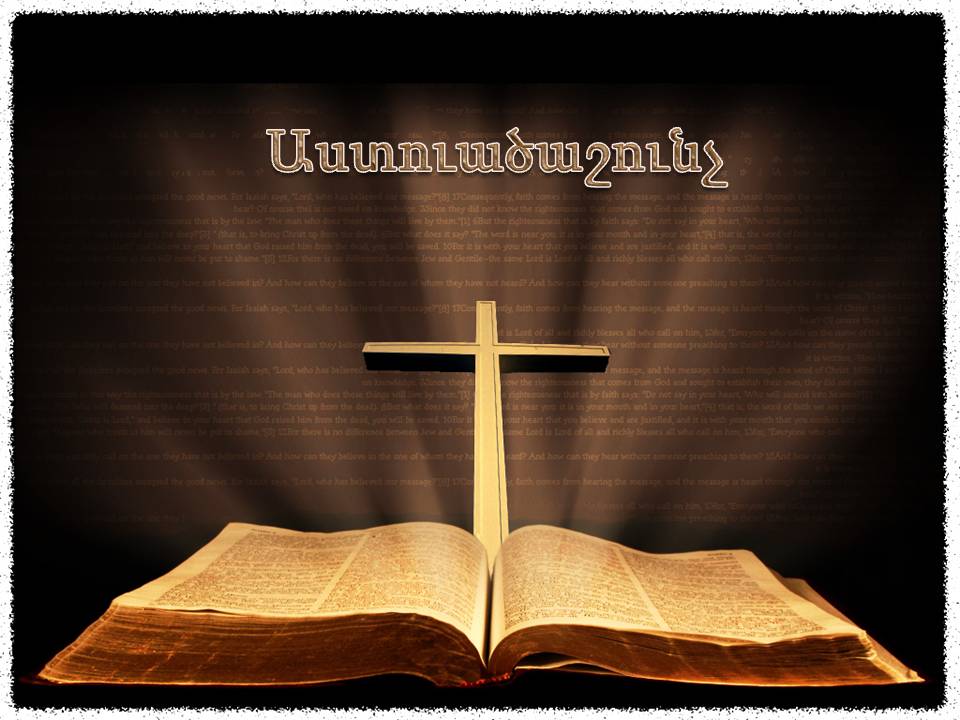
This sentence became the driving force behind the work of the Holy Translators because in their understand it was the beginning of our daily Christian faith. For these saints, translating the Holy Bible into Armenian was more then just changing the language. For them it meant that everyday people, young and old, rich or poor, could open their own Bibles and read the words and teachings of God – they could pray in their native language. People learned about God’s love for us and we also learned how to love Him back by loving one another, being kind and respectful to one another. We learned how to pray, how to feed, how to care for one another – in essence we learn God’s language of love. As St. Paul teaches in 2 Timothy, “All scripture is the breath of God for teaching, for reproof, for correction, and for training in righteousness” (v. 16) That is why in Armenian we call the Holy Bible the Astvadzashunch (Աստուածաշունչ), which means? “God breathing” or “breath of God.”
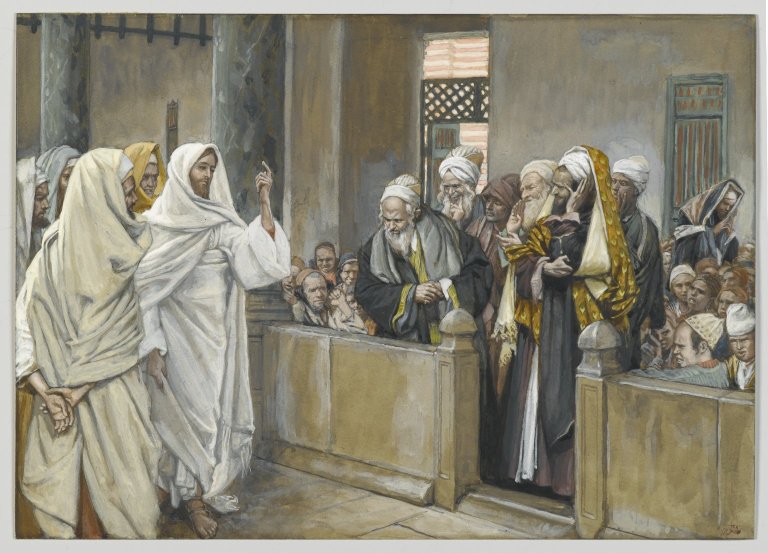
But why do we on this day also remember our teachers, priests, and parents along side these saints? They didn’t translate the Bible into Armenian. My dears, the word translate in Armenian does not mean only to change language but to transfer knowledge. To teach and illuminate in the same spirit by which those saints made the word of God accessible and relatable. In the Gospel today we read of how we must be careful of false teachers and leaders, “Beware of the scribes, who like to go about in long robes, and to have salutations in the market places…” (v.38) Christ is instructing us to be careful, because a real teacher, a real leader and a real translator is not someone who looks for recognition, pomp or glory, but rather, a true teacher is someone who is humble and does everything they can to teach others about the love of God. Someone who illuminates our minds to the truth.

My dears, we are all called to be teachers and translators, whether younger or older. We as Christian’s from our baptisms begin to learn that God loves us, and we must therefore, likewise, teach the world about God’s love. Some of us are teachers, some of us are priests, or parents, but all of us can teach by the life we live and it doesn’t matter if we translate and teach in Armenian, in English, French or Spanish. God understands all of us and with the Holy Bible has given us the instructions to understand Him. Yes, as Armenian Christian’s we have a special language that we pray with, we sing with and share God with. As Lord George Byron, an English poet from the 18th century, said, “If you sing, do it in Italian; if you confess love, do so in French; if you command, do it in German; but when you pray, pray in Armenian.” However, regardless of the language we feel comfortable using, God commands all of us to translate his message of love to others, to teach, to love and care no matter the language, no matter our age, no matter how smart we think we are, regardless, of our titles, stature, position, education, brokenness, pains and darkness, no matter who we are, God’s love is for all of us and He sent Christ Jesus for us, to give us life, to lift us up and to instruct us with wisdom.

Therefore, on the occasion of the Feast of Holy Translators we ask for the Holy Spirit to guide our teachers, parents, priests, students and all of us so that we will have a heart open to learn God’s wisdom and love and that we use what we have learned to teach other’s. Let us also ask for the intercession of the Holy Translators, Sts. Mesrop, Sahak, Yeghishe, Moses the Poet, David the Philosopher, Gregory of Narek and Nersess the Graceful and many others. May the love of God our Heavenly Father, protect us, fill us and lift us up. Աստուած օրհնէ Հայ ուսուչիչը, Հայ ուսանողը, Հայ Ազգը, մշակոյթ ու ժողովուրդը եւ մանաւանդ Հայոց լեզուն։ Amen!


Authority To Do Greater

Passages: Is. 17:7-14; 2 Corinth. 13:5-13; Mark 11:27-33
Ընթերցուածքներ՝ Եսայ. ԺԷ 7-14; Բ Կորնթ. ԺԳ 5-13; Մարկ. ԺԱ 27-33

In the name of the Father, Son and Holy Spirit, Amen!

Almost everyone today, living in modernity, boasts about one thing over all else: our right to do blank. The current political and social climate has created a polarizing atmosphere, where we feel our rights, our freedom and the authority by which we enjoy those freedom’s is daily being questioned or at times offended. We speak out about our rights as humans, as citizens of this country, as Christian’s, as men and women who live in a free society to defend those rights and especially the authority by which we enjoy those rights.

After all, we have the authority to speak out about our rights through the laws that govern this land, whether it is the Constitution of America, the Bill of Rights in Canada, the Miranda rights for the police, or any other legal documents, these serve as the authoritative base by which we are allowed and able to speak out, share or even complain when we feel hurt, offended, or limited. The authority which we have been given through those documents clearly tell us – that we have the right to blank.

As Christian’s, we know however, that the ultimate authority over us is God because God is the judge; God is the Creator; God is All Powerful and Man loving. And through that love and power, God created us and has given us free will and certain authority. This Divine authority is the same authority by which Christ Jesus spoke and performed his miracles as we read in the Gospel, “…the chief priests and the scribes and the elders came to him, and they said to him, ‘By what authority are you doing these things, or who gave you this authority to do them?’” (vv.27-28) Jesus Christ does not reveal to the scribes at that time by whose authority He ministered, because he knew the reasons why they are asking. However, we know that Christ’s authority comes from God the Father, as we read later on after Christ’s Resurrection at the Holy Ascension – “all authority on Heaven and on Earth has been given to me…” Yet, the passage does not end there and we see that that authority which he has been given, he gives to us. A divine authority which we need to truly reflect on daily in our Christian lives.

What does God’s given authority allow us to do? As the children of God what does that authority allow and/or require of me? As the Proverbial saying goes, “with great power comes great responsibility.” St. Paul teaches us, “Examine yourselves, to see whether you are holding to your faith. Test yourselves. Do you not realize that Jesus Christ is in you?” (v.5) We have authority my dears but what is it that we do with such power? Do we have the right to speak up? Yes. Do we have the right to fight? Yes. Do we have authority to demand justice? Absolutely. Do we have the right to self determination and identity? Yes. If we have the right and the authority to do all this and more, why is it that when we choose to speak up, we rarely speak up for the oppressed, the hurt and broken but instead speak up against God, or against one another by trying to justify our own sinfulness and wrongdoings? Instead of using our authority to fight for those who are defenseless or powerless, why do we fight each other, we fill our homes, Church, communities with hatred and arrogance? With the power to demand justice, why do we look for revenge, for spite, and demand personal retribution in place of demanding justice for the falsely accused and those who are drowning under their self-imposed chains? We have the authority to choose who we are and yet, how often do we choose to identify and learn to be Christ Jesus to the world?

My dears, yes, we have authority, we have rights, we have privilege and the truth is even though God has equally created and given us all the same free will there are some who have more rights than others depending on where in this world they live. However, the authority that we have been given by God is not merely one we use to shout slogans with or to demand personal agenda’s with in society or from our governments – it is much more powerful, for it is authority to drive out demons, heal the sick and bring light to the world around us. During our baptism, the priest prays “Redeemed by the blood of Christ from servitude to sin, he/she receives adoption as a child of the heavenly Father to be a joint-heir with Christ and a temple of the Holy Spirit.” In other words by the same authority that Christ lived, ministered, healed, died and was resurrected – we too have that same authority through our baptism. “Truly, truly, I say to you, he who believes in me will also do the works that I do; and greater works than these will he do, because I go to the Father.  (John 14:12) The authority by which Christ Jesus ministered and which was given onto us is to go forth, teach, and baptize. In others words our authority gives us not just the rights but the responsibility to bring others to God through the life we live, through our actions, our words, and our identity. To do greater works that that which we have read and see about in the Holy Scriptures. Therefore, the proverbial teaching is not correct that with great power comes great responsibility, because as Christian’s we know that with great power comes a greater and divine responsibility.

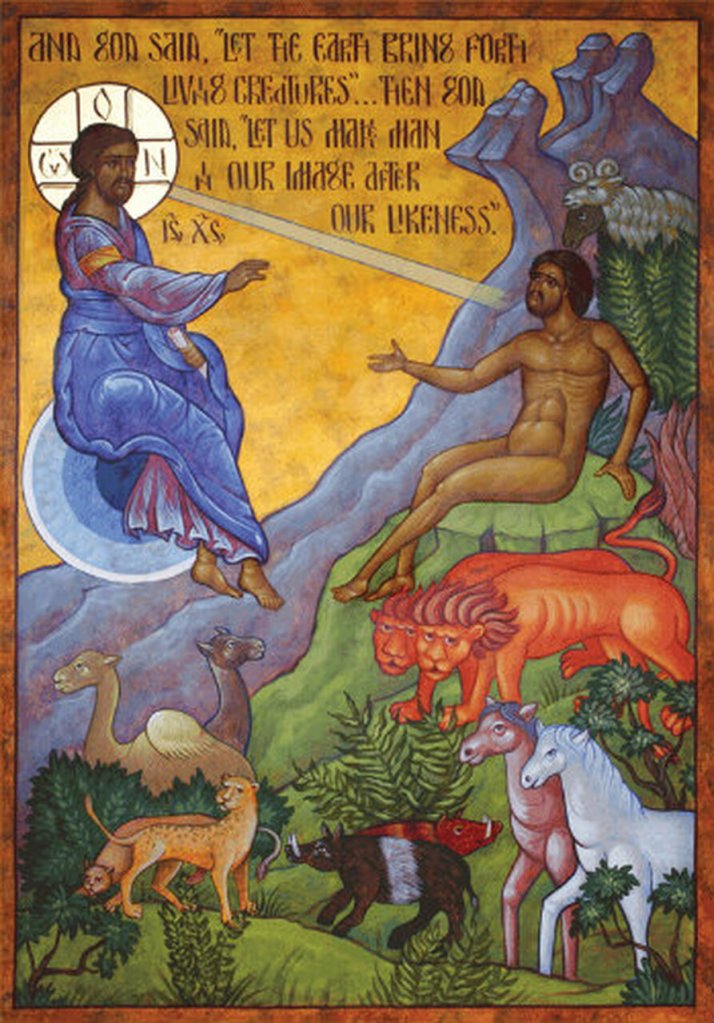
What we do as Christian’s, as those who have Christ in us, we must leave this world better than what we have found it and this was our charge from the very beginning of time. When God created Adam and Eve, the very first commandment, the very first task God ever gave humanity was what? “Then God said, “Let us make man in our image, after our likeness; and let them have dominion over [it].” (Gen. 1:26) God gave us authority over His creation to us as caretakers, as Stewards, as gardeners and keepers, to continue to build up, strengthen and fill.

As St. Paul continues today in verse 10 – “…in order that when I come I may [not have to be severe in my] use (of) the authority which the Lord has given me for building up and not for tearing down.” We must build up, but how are we building up? How are we building up this Church, our homes, ourselves, our children and families? How are we building up with the authority we have been given?

Yes, my dear brothers and sisters, we have rights, and we have authority to demand rights in this life. We should respect those rights and the rights of others yet as children of God, who have been baptized and anointed, we have a divine authority and responsibility to love, hope, heal, care and build up God’s presence in this world through the life we live – To be a light for those in darkness by taking the light which has been given to us here through Christ Jesus. As St. Paul teaches us, “Mend your ways, heed my appeal, agree with one another, live in peace, and the God of love and peace will be with you. Greet one another with a holy kiss. All the saints greet you.” (Vv. 11-13) And doing so, we shall go forth teaching who God is with true authority and thereby bring Him, our Heavenly Father, along with the Son and Holy Spirit, true glory, Amen!

Holding On

Passages: Prov. 3:18-26; Is. 65:22-25; Gal. 6:14-18; Matt. 24:30-36
ԸՆթերցուածքներ ՝ Առակ. Գ 18-26; Եսայ. ԿԵ 22-25; Գաղ. Զ 14-18; Մատթ. ԻԴ 30-36

In the name of the Father, Son and Holy Spirit, Amen!

As an Armenian clergy, one of the benefits of my “job” is that I not only spend time ministering to Armenian’s but also to many who are not Armenian, Christian, or familiar with the Church. That ministry to non-Armenian’s is not just outside these walls, with ecumenical or social groups. Often times, our community is blessed with visitors for whatever reason and my ministry is presented with an opportunity.

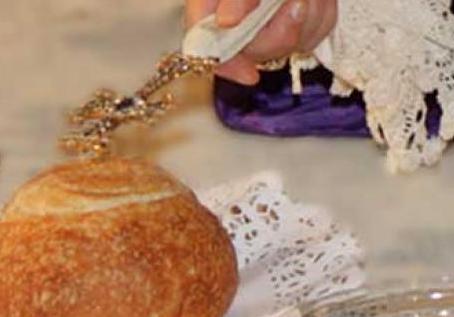
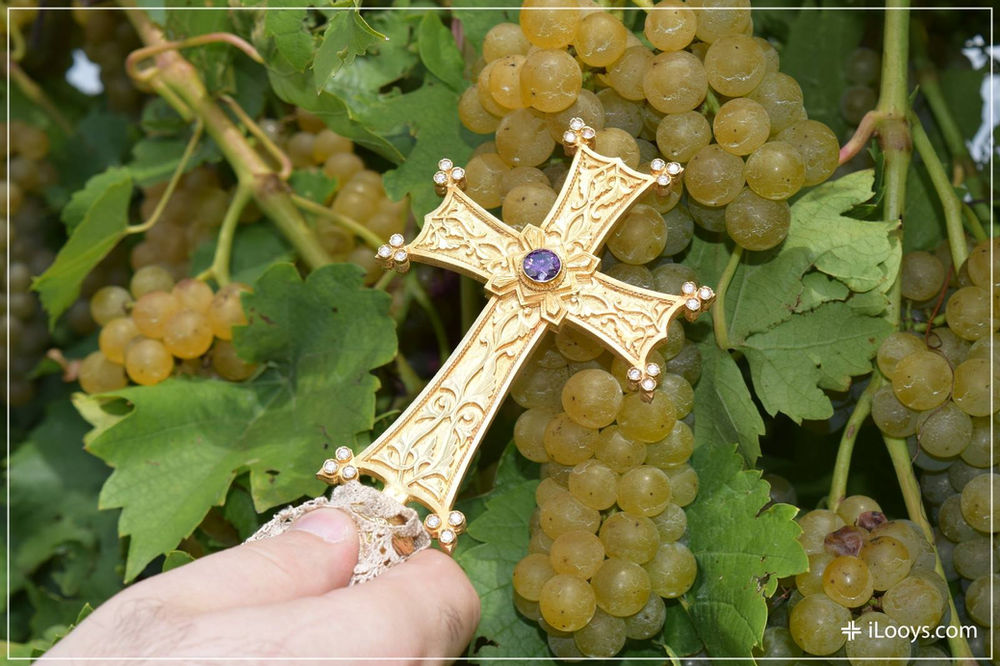
One day after a service, whether it was Badarak, a funeral or another sacrament, a visitor came up to me and said how amazed they were that as a priest I held a hand cross while speaking and which gave me authority as a Christian to speak, but that I held the cross with a special cloth, or that when reading the Holy Gospel again we held it with a cloth. They were amazed to hear the explanation that as Armenian Christian’s we believe in the reverence of the Holy Cross and Word of the Holy Gospel and that we choose not to hold onto these merely with our sinful hands but with a cloth to keep it clean. As a clergyman, sure I knew the reason behind it, yet, I had never really given it much thought that perhaps other Christian’s do not do the same; to be honest I am sure many of us have not either.

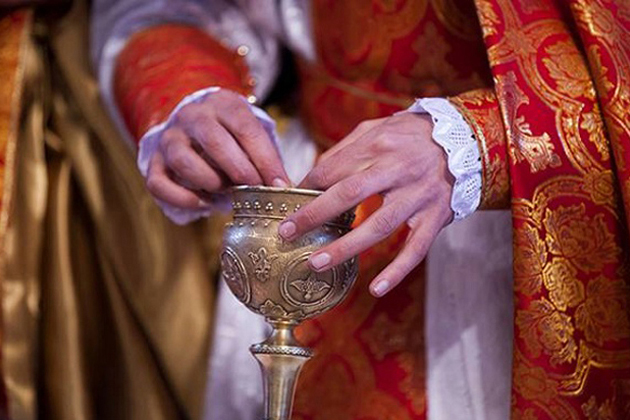
We use our hands to for many things. We hold onto money, keys, our phones, and to everyday items; we use our hands to do good and evil, we use our hands to greet one another and hold onto the things that matter most to us. Then without much thought, we come and grab our Cross, our Bibles, the mass or even Holy Communion with those same hands.

Now it isn’t that we are dirty or can’t use soap to clean our hands, nor is it that we are so sinful that we are unworthy because our worthiness and true cleanliness comes from being in Communion Christ Jesus. As many of the Holy Church Father’s teach us that as unworthy as we are, to us, His children, God have His flesh and blood to touch and consume, yet, the priests and prophets of the Old Testament were not even able to enter the Holy of Holies.

Therefore, if it is not only a matter of the physical cleanliness of our hands or our faith, why do we use this cloth and other cloths like these? My dears, it is a matter of our heart and mind. You see the Armenian Church, along with the other ancient Churches uses symbols like this cloth to remind us of the holiness we embrace and are surrounded by. As we embrace these, as we hold onto the cross, the Gospel, etc. we are also called to think about, what else is it that we are holding onto in our lives? Not only with our hands but also our hearts and minds; In other words, my dears, what is it that we place our trust in? In Proverbs we read, “She is a tree of life to those who lay hold of her; those who hold her fast are called happy.” (V.18) What is this tree of life? We read a few verses earlier, it is the Lord’s discipline, Wisdom, commandments, and teaching. When we as Christian’s hold onto these things, we are holding onto God. But what does this look like?

A few weeks ago, on the Feast of the Exaltation of the Holy Cross, we stated that the Holy Cross is what? A witness and a remembrance of God the Father’s ultimate act of love through God the Son, Jesus Christ. To hold onto God, to follow His commandments, discipline and wisdom, means that we hold onto that love. We remember and we live accordingly, because it is that love which looked at our sinfulness, our brokenness, our depression, anxiety, oppression, hatred, arrogance, and spitefulness; it is that love that broke the artificial lies of the devil who says that we are beyond God’s forgiveness. And that love healed us, lifted us up, consumed us like a blaze and brought us into the communion with God. Whether or not we use a cloth or our bear hands ultimately the question is what do we choose to hold onto, to guide us, to heal us, to free us in this life? Do we hold onto philosophies, yoga’s and other exercises, science, medicine, people, politics, etc.? Do we hold onto personal opinions, social media blogs, slogans or self-help teachings? Do we hold onto our jobs, education, titles, ambitions, failures, success, desires, relationships? Do we hold on to fear, anger, frustration? Though not all of these are not bad or evil in and of themselves, and they can be helpful at times, but which of these is the tree of life through which we are truly healed?

My dears for us who believe in the love of God, in Christ Jesus who died for our sins and rose from the dead, we hold onto to Him like a child holds onto a parents – with trust, hope and love. We cling to our Holy Cross, our Holy Gospel not only as a physical item but through the life we live following the teachings, the wisdom, the commandments, and the love of God which tells us to repent, hope and trust in Him by loving each other, loving ourselves and turning to Him. “For neither circumcision counts for anything, nor uncircumcision, but a new creation. Peace and mercy be upon all who walk by this rule…” (vv. 15-16) Yes, my dear brothers and sisters, circumcision or not, meaning regardless of what laws, teachings, exercises, hopes, dreams, promises or even pains and darkness we follow or have surrounding us in this life, no matter what worldly things we believe in or trust, in the new creation, meaning life in Christ Jesus, is the only way to have healing, peace, and mercy.

What is it that we holding onto? Hold fast to your cross, hold on to the Word of the Holy Gospel, hold fast to each other, use a cloth or not, but hold on to God’s love by following His commandments, yearning for His wisdom, asking questions to learn His teachings. Let us hold onto the tree of life, Christ Jesus, through whom we receive eternal life. And by holding on, let us live our life following Christ’s example, following the commandments of God, making Wisdom our compass and the love of God our light. May that life in God’s love bring healing to us and the world around us, Amen!

Duck and Cover?

Passages: Isaiah 49.13-23; Galatians 6.14-18; John 3.13-21
Ընթերցուածքներ՝ Եսայ. ԽԹ 13-23; Գաղ. Զ 15 14-18; Յով. Գ 13-21

In the name of the Father, Son and Holy Spirit, Amen!

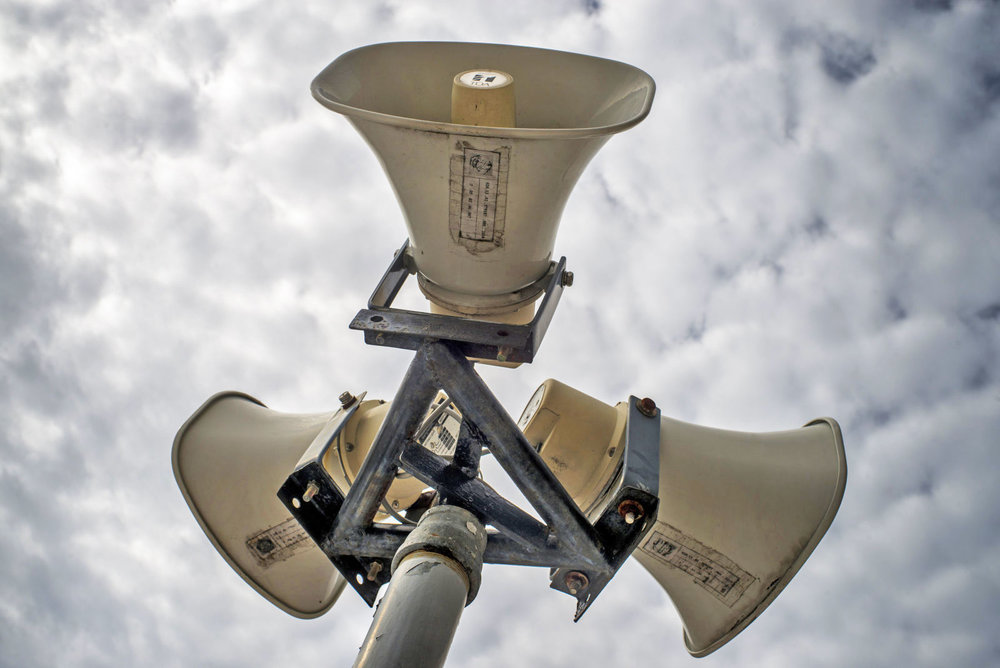
In the early 1950s up until the late 90’s, schools across the United States and Canada trained students to dive under their desks and cover their heads any time they heard the sirens blare. The now-infamous duck-and-cover drills simulated what should be done in case of an atomic attack, which began from the days of the Cold War, as fear filled the lives of people across the world. All throughout the world up until the Iron Curtain fell, fear of a nuclear attack was imminent and very real.

Once the Soviet Union fell, fear remained as to what would happen as all these new countries declared independence and as the technology and arms war continued. Slowly fears of foreign nuclear attack dissipated, until 20 years ago on 9/1,1 2001 when a terrorist attack took the lives of thousands. No, it was not a nuclear attack, it was not a crazed gunman – but the attack was real, and devastating and there was nowhere to run or hide; there was no desk we could dive under; the siren’s blared and fear again filled our hearts.

I’m not sure where this practice was created but I’ve never understood how a desk and chair could protect against any attack especially a nuclear attack. It’s a piece of wood with some paint over it, how could this really protect me? As Christian’s, from the moment we are baptized, we are taught that true protection comes from the Holy Cross. Ye, I wonder, have we perhaps asked the same about the cross as I asked about the desk – how could this really protect me? It’s a piece of wood or maybe some sort of metal. Can the cross protect us from nuclear war? Can the cross protect us from sickness, loss of life, anxiety, depression, or other worldly pains? Can the cross protect us from a terrorist attack?

At the end of every service in the Armenian Church the priest blesses us by saying, “protector of the faithful Christ our God, protect and free your people by the sign of the Holy Cross keeping us safe from visible and invisible enemies…” Similarly, when a priest prays for healing over someone, we say “By the sign of your all powerful and conquering cross bring healing and aid to your servants…” My dears unlike our desks in school, which we falsely believed would protect us from any real danger, the power of the Holy Cross is not in the material it is made of but the symbol for which we as Christian’s, as St. Paul teaches, take glory in. For the ancient world, and even for many today, the cross is seen as a tool of death. It was used to crucify criminals and it was used to kill our Lord. However, the cross of Christ Jesus, which we glorify and look to for protection and healing is a witness to the great act of God. The wood, silver, gold or whatever material it is made of does not bring protection, rather the Holy Cross itself reveals to us that Christ Jesus is victorious over sin, the devil, demons and death.

That is why when we buy a cross or get one as a gift, we must bring it to Church to be blessed before we wear it because the material is useless rather, it is God through our prayers that makes the cross into lifegiving.

Christ Jesus through His death and resurrection made the Holy Cross a tool of faith and protection rather than fear and death. As the 8th century Church Father, St. John of Damascus teaches us, “We venerate the Cross of Christ, by which the power of the demons and the deceit of the devil were destroyed.” No, the cross is not a lucky rabbits’ foot, a 4-leaf clover or any other talisman we hang in our homes or around our necks; It is not a bullet proof vest, or a nuclear bunker, or a desk we jump under when we hear the sirens blare. The cross of Christ is the powerful symbol which reminds us that we are loved despite our flaws and sins. The Cross draws us closer to the mystery of Jesus and his power over death, for the Cross focuses our hearts and minds on Jesus Christ and His love for us. The power, protection and healing of the Cross comes not from the material but that through it we begin to know God. That is why Christ tells us to pick up and carry our cross – it means live and be a witness of God’s love and healing to the rest of the world.

Therefore, my dear brothers and sisters, when in life we hear the sirens blare telling us to dive under our desks, when we face fear, depression, anxiety, sickness, hopelessness, darkness or even when we enjoy joy and good health, let us pray by crossing ourselves, looking to the Holy Cross for thanksgiving, protection and healing. For the Cross is a reminder and symbol of life after death, of freedom from sin, and of the ultimate love. “For God so loved the world that he gave his only Son, that whoever believes in him should not perish but have eternal life.” (John 3:16) “Sing for joy, O heavens, and exult, O earth; break forth, O mountains, into singing! For the Lord has comforted his people, and will have compassion on his afflicted.” (Isaiah 49:13) “Peace and mercy be upon all who walk by this rule… Henceforth let no man trouble me; for I bear on my body the marks of Jesus. The grace of our Lord Jesus Christ be with your spirit, Amen.” (Galatians 6:16-18)

Use Wit

Passages: Isaiah 13.2-11; 2 Corinthians 7.4-16; Mark 7.31-37
Ընթերցուածքներ՝ Եսայ. ԺԳ 2-11; Բ Կորնթ. Է 4-16; Մարկ. Է 31-37

In the name of the Father, Son and Holy Spirit, Amen!

“Often held but never touched, always wet but never rusts, often bites but seldom bit, to use me well you must have wit. What am I?” This children’s riddle speaks about our tongue. And while it is only a children’s riddle, the final words hold a deep truth – “to use me well you must have wit.” Today with social media commenting, instant messaging, text messaging, etc. all of us have the boundless ability to use our physical and or digital tongues” to express opinions, thoughts, concerns, and ideas.

However, sadly, too many people today do not have or use wit, and we do not tame our tongues in how and what we say to each other or to ourselves. Just because we have a tongue, it does not mean we know how to use it.

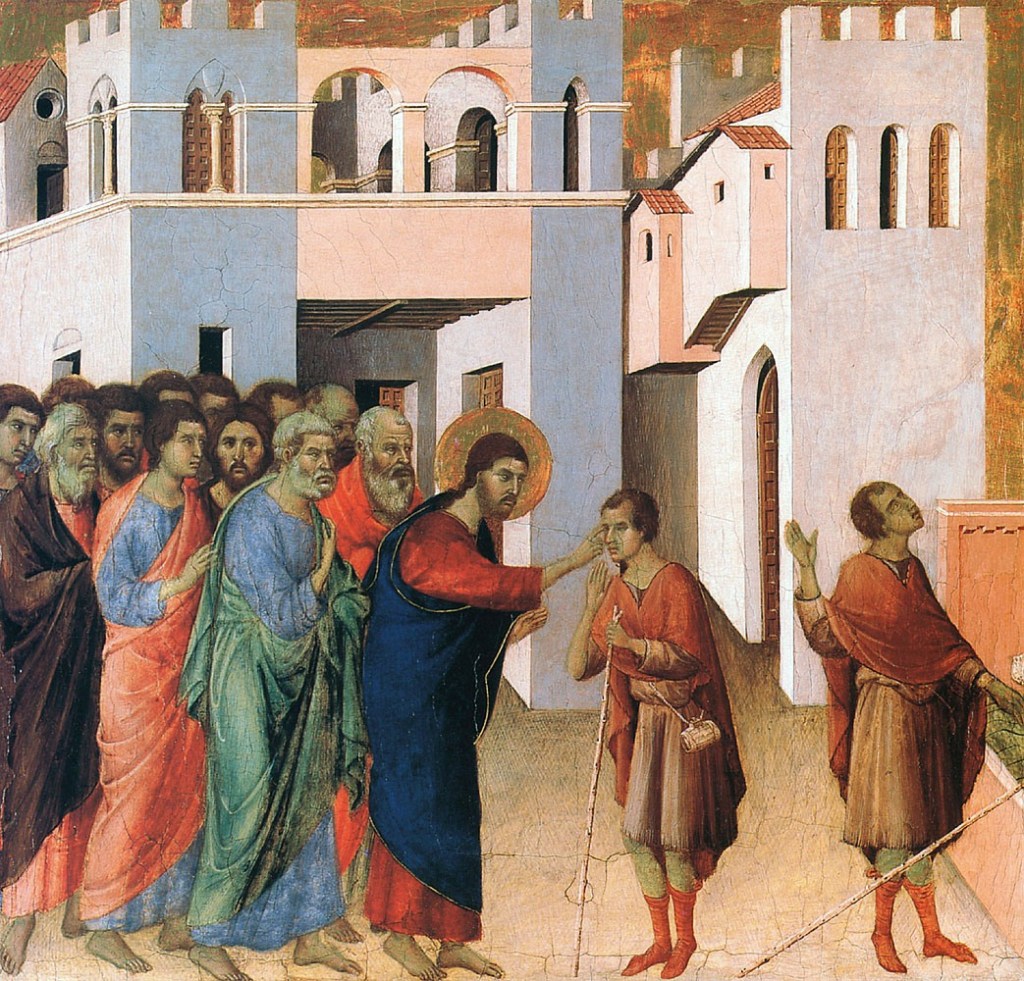
In the Gospel today, we meet a person who had a tongue but is physically unable to speak, “And they brought to him a man who was deaf and had an impediment in his speech; and they sought him to lay his hand upon him.” (v.32) And we know that Jesus heals this man by saying Ephphatha which means be opened. However, what is opened? His tongue, his ears? Is Christ giving this man the ability to use his tongue or is it something else? In the Gospel of Mark 8 and John 9, we read of how Jesus heals blindness. In Mark 2 – Jesus heals the paralytic by forgiving his sins. In Matt. 8 – Jesus heals a leper. Etc. we all know of the multitude of stories where Jesus heals the sicknesses, ailments, the physical, spiritual, and mental brokenness of humanity – however it is only in this instance where we read of Jesus healing by saying be opened. If in the 1st century, a mute person could not express themselves easily; today, with technology they can. Does that mean we don’t need Christ? Absolutely not.

It means we need to understand what it means when Christ Jesus says, “be opened.” My dear brothers and sisters, when Christ heals us and breaks the chains of our sins it is not merely a physical healing that takes place but a much deeper and profound healing. In the letter of St. Paul to the Corinthians we read of how St. Paul is proud that our suffering, our pain and grief has led us to repentance. No, this doesn’t mean that St. Paul is a masochist, who takes pride in our pain. Rather, St. Paul sees that through grief, our eyes, ears, tongue, and senses have been opened and now we understand that only with Christ our Lord can we find true hope, healing, peace and relief of that pain.

When Christ heals with the command Ephphatha, He is not only physically healing our ailment but is opening our spiritual tongue and ears to turn us towards repentance and a deeper healing. The man in today’s story I am certain, had seen plenty of doctors and healers – none which were able to heal. If anyone of us became deaf or mute or if we had a child who had these ailments, the first thing we would do is what? Go see a doctor. And with today’s technology and medicine, or even sign language, deafness and muteness could be overcome. And yet, Christ healing the tongue and deafness of this man did much more.Healing in Christ Jesus, being opened by Christ Jesus is much deeper. Because our prayers are not incantations, and Holy Communion is not an Advil which we take to get what we want or to take the pain away in life. And we know that in this life, whether we are Christian or not, we get sick, we suffer, we are born with shortcomings. Yet, true healing takes place when we live in Christ. When we have questions and inquiry about our faith, when we come to Church and ask those questions, when we repent, pray, fast, and trust in God, then true healing will take place. A healing that will open our eyes, ears, mouth, tongue, hands, and feet to speak, act, and do that will of God.

My dear’s God has blessed us with many tools and has given us the instructions on how to use those tools to bring blessing and healing into this world. Through sin, sickness, perversion and lies have polluted and blinded us from seeing and hearing the truth. Our tongues have been bound and we have been left in pain and suffering. However, if we come with faith to Christ our Lord, when we repent, He will take hold of those chains break them and command, Ephphatha – be opened, be healed, be free. May we use that freedom, and healing to build each other up and not tear each other down. Use wit, love, and patience to tame our tongues in the words and ideas we share with each other. Let us come to Christ and ask Him to heal us, take our weakness and say Be Opened. May the life we live therefore, glorify our Heavenly Father, the Son and Holy Spirit Amen!

Let Us Pray They Do!

Passages: Zech. 2:10-13; 2 Corinthians 6:16-7:1; Luke 1:39-56
Ընթերցուածքներ՝ Զաք. Բ 10-13; Բ Կորնթ. Զ 16 – Է 1; Ղուկ. Ա 39-56

In the name of the Father, Son and Holy Spirit, Amen!

One day a young pastor, in a relatively poor neighborhood, led a group of faithful throughout the streets where he and his flock handed out bagged lunches to the homeless. He observed the different types of people he met along the way. Some were young, old, men and women, drug users, alcoholics, all kinds of people who through life’s different circumstances and challenges had unfortunately ended up homeless. Among those homeless were also a few some prostitutes, regular, but also cross-dressing prostitutes – men who dressed as women and who sadly lived a life of godlessness, perversion, and exploitation.

Regardless, the young pastor gave them sandwiches as well, and even invited them to come to his Church if they would like. Sadly, the reality is most of the time when we as pastors and priests invite anyone to come to Church the answer we receive is, “thank you Der Hayr or pastor, we’ll think about it, or we’ll try” yet, majority never come. In the same way, one of the cross-dressing prostitutes said to the pastor, “thank you pastor, I’ll think about it.” Weeks passed, months passed, and the pastor continued with his ministry, occasionally driving down the street where he had handed out a meal and an invitation. One day, while delivering his homily, he saw a couple of new women quietly walking in and sitting in the very back of the Church. No one gave notice or anything, but the pastor made a mental note to go up after the service and introduce himself. As he went up to them and extended his hand, he recognized these women as the cross-dressing prostitutes. One of them came up to the pastor and said they had accepted his invitation and came to see the Church. And while the pastor struck up a conversation with them, from the side he noticed (and pastors notice a lot of things) that some people were looking at these prostitutes with disgust and rejection. It was only natural because regardless of their appearance or homeless stature, majority of society does not associate with prostitutes or drug abusers. When the prostitutes had left the Church and had said they would return soon, one of the parishioners came up to the pastor and asked, “what did they want? Money?” The pastor said “no, they were searching for God and want this Church to be their home.” The parishioners surprised and alarmed asked, “does that mean they are coming back?” To which the pastor responded, “let us pray they do.”

My dear brothers and sisters, in 2 Corinthians we read, “What agreement has the temple of God with idols? For we are the temple of the living God… beloved, let us cleanse ourselves from every defilement of body and spirit, and make holiness perfect in the fear of God.” As Christian’s and as children of God, we are called to be cleansed from every defilement – such as hatred, perversion, malice, lust, bigotry, superstitions, laziness, etc. We are called to confession, repentance, and Holy communion by which God cleanses us of those vices and passions and makes us into His temple. However, I wonder, how would we behave towards prostitutes, criminals, the homeless, those considered on the bottom of the totem pole of society if they walked into our Church today? Perhaps it’s difficult to be accepting of individuals like that as there might be a danger of what they will do such as they might have a weapon, etc.

So let me ask a different way; how would we behave, receive and act if someone we don’t like, someone who has hurt us, someone who has betrayed us, or is dressed in a way we don’t like, or smells strange, or is mentally handicapped, how would we feel if they came searching for God in our beloved little Church today? If we are honest with ourselves, most of us, here or watching at home, would not be open or accepting. We would not only physically be guarded, which is not wrong, however, though we might not say anything publicly but in our heart and mind we would be cursing them and wishing they would just go away: “What do they want? Why are they here? Can’t they see they’re not wanted?” St. John Chrysostom teaches us, “If you are coming to Church looking for Holy people, you are in the wrong place. However, if you have come looking for God, then you are on the right path.” My dears, why do we come to Church?

Are we here because Der Hayr has a nice voice or gives a decent homily once in awhile? Are we here because our parents or grandparents helped build this Church and so we have an obligation? Are we here because it’s Sunday and the weather isn’t the best and there is free coffee in the hall, so we decided to come to Church? Or are we here seeking out God? Coming to Church because we enjoy the Badarak, because we want to honor our families legacy, or because we can share in fellowship in the hall is a good thing. But these should not be the reason we come to Church. We don’t come to Church to seek like-minded people or to listen to the latest gossip rather, we come to Church only to seek God and to listen to His message in our life; to be transformed and challenged. Or else all of this is a waste of time and even though we are here, our hearts and minds are not cleansed, and we do not become the temple of God.

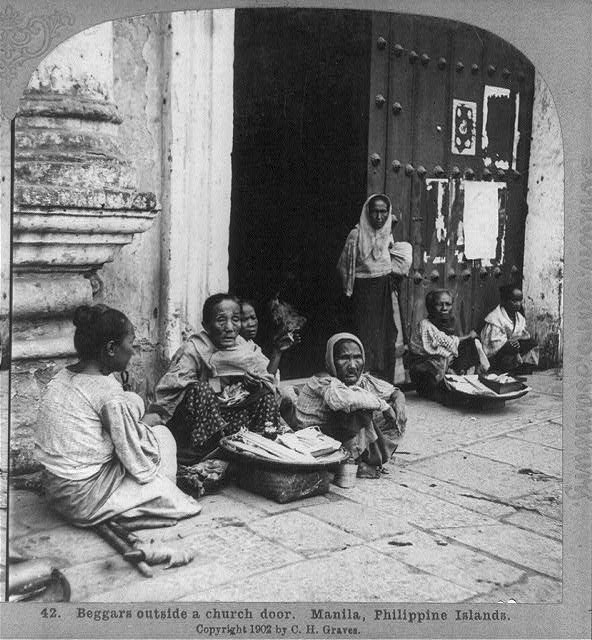
My dear brothers and sisters, we all have darkness in our life. We all have battles we face daily, sickness we fight privately, anger we deal with regularly and many other struggles that we can only overcome with God. It may be easy to judge those who outwardly dress, act, or live differently than us, such as a cross dresser, prostitute, or homeless beggar in the street. However, when we, who have put on Christ through our baptism, judge others out of hatred and bigotry and we do not live with repentance and humility – we become a cross dresser, who puts on a garment foreign to who we are called to be. When we place our trust in other worldly things, superstitions, and beliefs – we become the prostitute who sells our soul to godlessness and idolatry. When we come to Church making excuses as to why our hearts can’t change, or why we know better than the “others” – we become a homeless beggar, who does not dwell in the house of God but searches for scraps of hope in darkness.

And so as the young pastor responded to his parishioner who asked, “you mean they’re coming back”, I pray, let us all pray, that this Church be the place where the sick, homeless, abandoned, hated and broken come searching for God, where we come searching for God. Because the Church is a place we find healing, comfort and peace. The Church is a hospital for the sick and infirmed. The Church is our home, where all are invited to gather no matter life’s circumstance, in order to change and grow. For it is here we begin our communion with God, through the body and blood of our Lord and Savior Jesus Christ, who died for us, gives us life and cleanses us of sin. It is here we learn to become a temple of God void of idols. And when God is in us, He will work through us, to invite, feed, clothe and heal others.

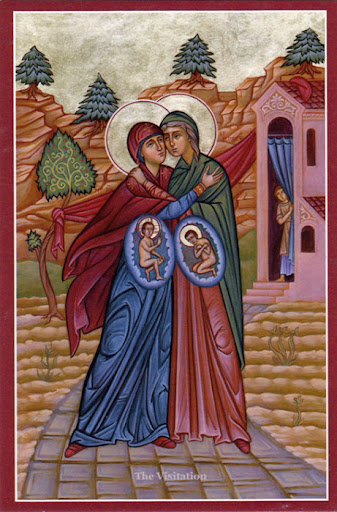
Our beloved and blessed Virgin Mary, when speaking to Elizabeth quotes the Psalmist, “My soul magnifies the Lord, and my spirit rejoices in God my Savior, for he has regarded the low estate of his handmaiden…” God has regarded our low estate and has lifted us up – God knows that we are all broken and lifts us up. Let us humble ourselves, come here seeking Him only, and He will raise us up, heal us and bring healing to others through us. For we are the temple of the living God, where Father, Son and Holy Spirit reside. God cleanses us, vests us in His beauty and makes us His living presence in this world so that we will go forth, teach and preach by extending out our loving hands and inviting others to come here as well. Thereby, glorifying our Heavenly Father, the Son and the Holy Spirit, eternally, Amen!

We Matter Through Christ

Passages: Isaiah 7:10-16; Gal 3:29-4:7, Luke 2:1-7
Եսայու Է 10-16 ; Գաղ. Գ 29 – Դ 7; Ղուկ. Բ 1-7

In the name of the Father, Son and Holy Spirit, Amen!

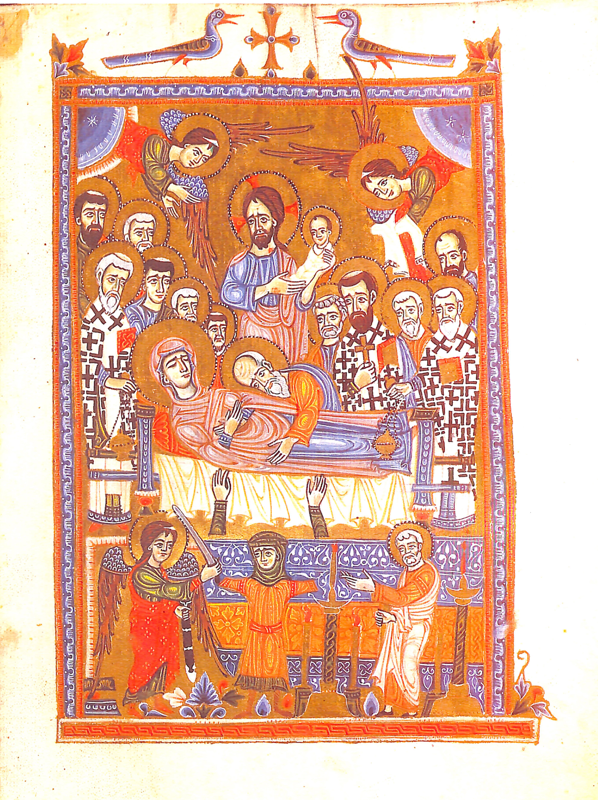
What do is today? What is it that we as a Church are celebrating? The feast of the Assumption of the Ever Holy Virgin Mary. What do we know about this feast day and where does it come from? According to scripture, at the crucifixion of Christ, Jesus, off of the cross, gave care of his mother to his beloved disciple John. St. John along with the other disciples cared for St. Mary as their own mother until her last days, when she fell asleep. Tradition says that after St. Mary was buried at her family tomb in the garden of Gethsemane, St. Bartholomew, who was absent at the funeral, asked for the tomb to be opened so he could offer his prayers.

When St. Mary’s tomb was opened, her body was gone, and the voices of angels were heard singing and the disciples knew that Jesus had come back and taken her up to heaven. Therefore, we also believe that Christ Jesus, loved his mother so much, that he returned to assume her, take her up, to Heaven. So we know the story and we know that on this feast day, the Armenian Church blesses grapes. Along with the grapes in the prayer service, we also bless the harvest of the year, all fruits, and vegetables. Now looking at these two individual events, today’s feast day and the blessing of the grapes, what on earth do they have to do with each other? Something doesn’t make sense.

Additionally, look at the scripture readings of today, it’s not the story of St. Mary or of her dormition (passing), nor is it about Christ calling himself the grapevine. For those of us who are familiar with the readings in the year, this is the Gospel that we read on Christmas morning and the letter of St. Paul which we read during baptisms. So what does this all have to do with each other?

About a week ago I had the opportunity to be a keynote speaker for a retreat for a group of Indian Orthodox Christian’s. The topic of the retreat was focused on our understanding of who is Christ Jesus. One of the passages I referenced was John 14:6 “Jesus said to him, ‘I am the way, and the truth, and the life; no one comes to the Father, but by me.’” And one of the participants asked what does it mean to say that Jesus is the way, or the path?

My dears in our lives we each face challenges; we face highs and lows, success, and failure; throughout our life journey we may go over hurdles, face adversity, go through darkness; we may fall, get back up only to fall again. Each of us are on a path that is the same but unique to us. Therefore, how we understand the words of Christ is that when we seek out God, eventually our paths cross into and merge with Christ and if we want to grow in our knowledge of God, our journey must continue through Christ Jesus. And this is how all of these things: the assumption of St. Mary, the blessing of grapes and the scripture readings of the day, merge and teach us. It is Christ that unites us and brings us into communion with each other, with Him and with God the Father and Holy Spirit!

St. Mary the Mother of God, the Theotokos, the Holy Virgin, matters to us all, is the mother to us all and is an example to us all because of Christ Jesus. These grapes, as delicious as they are by themselves, through the prayers they are a constant reminder of all the blessings we receive from God and of how Christ Jesus chose these grapes to become the wine for His blood, by which we are saved. Our understanding of the Holy Scriptures, salvation, our wisdom, our renewal, and our rebirth through baptisms and life in the Church ultimately begins from Christ Jesus, who frees us from our sins. Without Christ Jesus, St. Mary would be just like any other mother – beautiful and precious but not the mother of God. Without Christ Jesus, these grapes would be delicious, and the wine would be enjoyable but it would not be the blood of the new covenant. Without Christ Jesus, baptism would just be a public bath.

My dears, all these things matter and are connected through Christ Jesus. Each of us matter and are connected through Christ Jesus. Regardless of our age, our stature, position or title, our skin color, dress, body type, language, or gender; regardless, if we are clergy, altar server, choir member, parish council, or Sunday school student; regardless, if we have failed, continue to fail, if we feel like we don’t matter. My dears, we each matter through Christ Jesus. Yes, He is the way, the truth, and the life. But unless we pray from our heart, repent, and confess our sins, follow the commandments of God, read our scripture, and apply it all to our daily life – that way, truth and life will not be revealed to us because we’re trying to do it without Christ. It is only through Christ Jesus, who is God the Son, who lived and died for our sins, and who through His resurrection also gave us life and purpose; it is only through Him that we begin to see the connections, blessings, and importance of not just the stories of scripture but the stories of our own lives and the lives of those around us.

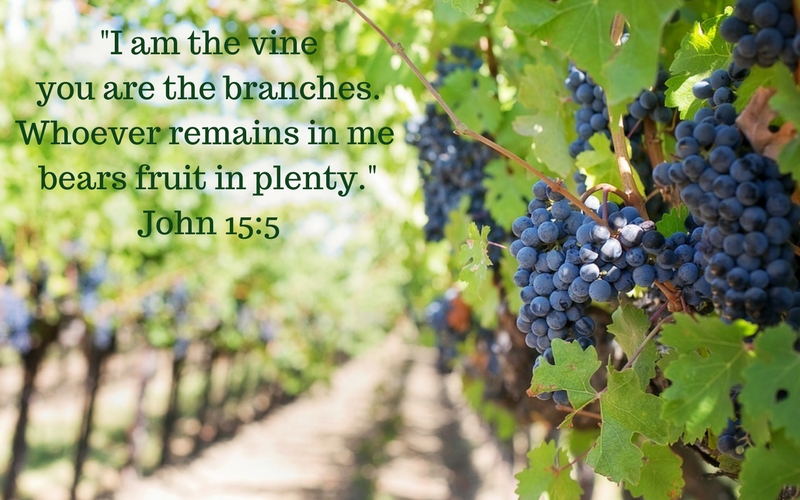
We all matter because we matter to God; We all are connected because we are connected to God. Therefore, my dears just as these cluster of grapes are connected to the grape vine, through which they receive their nutrition, let us remain connected and in communion with Christ Jesus the true vine. Let us also remain connected to each other through which we grow stronger. By living a life according to God’s commandments, no matter the struggles and darkness we face, our life will bring glory to God just as St. Mary’s life did, just as these grapes do, just as life in the Church does. May our eyes lift up to him, our ears be opened to hear His call and may we with faith, hope and humility approach to receive the Holy body and blood of our Lord Jesus Christ through whom we are also in communion with God the Father and Holy Spirit. And may the life we live, the path’s we journey on bring glory to God, now and always, Amen!

Answer the Call In Deeds

Passages: Isaiah 58:13-59:7; 1 Tim. 4:12-5:10; John 3:13-21
Եսայու ԾԸ 13 – ԾԹ 7; Ա Տիմոթ․ Դ 12 – Ե 10; Յով․ Գ 13-21

In the name of the Father, Son and Holy Spirit, Amen!

During the pandemic, all of us lived under restrictions and we were isolated and taught to distance ourselves by not going out to social events including not going to Church. As a need was created, the Church answered by beginning to live stream its services with live Sermons, Q&A’s, online Bible Studies, etc., all were created to reach out to all faithful. And I remember hearing repeatedly of how much people missed Church and the fellowship. Slowly restrictions were lifted, and we were once again able to gather in prayer and fellowship. Yet not everyone returned and even those who confessed they missed Church, they did not come back with a fervent desire to follow God. Caution became the new word. Yet, those same cautious people are out at bars, traveling on vacation, shopping through malls, and enjoying life. So, what can we say about the people who choose to live in such a way? Yes, we all have free will and are able to do as we please. Therefore, if there are those who choose to live in such a way that does not bring them back to God, how should we who claim to follow Christ, respond?

The prophet St. Isaiah and the Apostles St. Paul give us an interesting answer. Isaiah tells us that if we turn back and honor the sabbath, follow God’s will and desire rather than seek out our own, then we will be blessed, and our Lord will feed us. St. Paul on the other hand, likewise, blesses those who follow God’s commandments yet, tells us not to rebuke those who folly, those who mess up or perhaps don’t choose the path that leads to God. Therefore, how do we understand this? Aren’t we as Christian’s called to do the will of God on earth by bringing people to God? My dear brothers and sisters, when Christ Jesus, became man, took flesh, ministered to the sick and needy; when Christ fed the hungry, and blessed those who sought after Him, what did He command us to do? On the day of his glorious Ascension, what did Christ command of us, those who follow Him, who identify as His disciples? Go out and preach; forgive to be forgiven; love and pray for those who don’t love or pray for you; clothe the naked, feed the hungry and care for one another. In other words, my dears, Christ did not tell us go forth and bring judgement upon the heathens. God never told us to fight against evil amd God did not charge us to save the world. Rather, God reminded us, that we are all equally in need of saving and that salvation can only be done through Christ Jesus.

Jesus Was a Gospel Preacher – Counseling One Another

St. Paul teaches us not to be overly harsh of the youth, of those who don’t understand; neither of the old, those who are set in their ways and don’t know better. Rather, St. Paul directs us to live and serve as an example, “Let no one despise your youth, but set the believers an example in speech and conduct, in love, in faith, in purity.” (v.12) Take care of each other, the widows, the elderly, the weak, the youth – that is what we are called to do. In other words, do the will of God by living out His love. St. Isaiah likewise, reminds us, that if we follow God’s commandments, through love, hope, faith, and patience than we will be blessed. If we follow God’s commandments then the sick will heal, the hungry will eat, the thirsty will drink and the dead will rise not because we have some sort of power, but because we will have done these things through God. We choose to follow God, to believe in Christ Jesus because we know His love for us. And we know God’s love for us because we have witnessed it in multiple ways, and so we choose to follow. Through our free will, ultimately, we need to make that choice to believe, to follow and to live, in the same manner, for example, that it is our choice to obey our earthly parents, our doctors, our priest, our teachers, our leaders, etc. If we honor, we will be honored and enjoy the fruits of our faith. If we don’t honor, if we make excuses, if we lie or cheat, we will answer to God in the end.

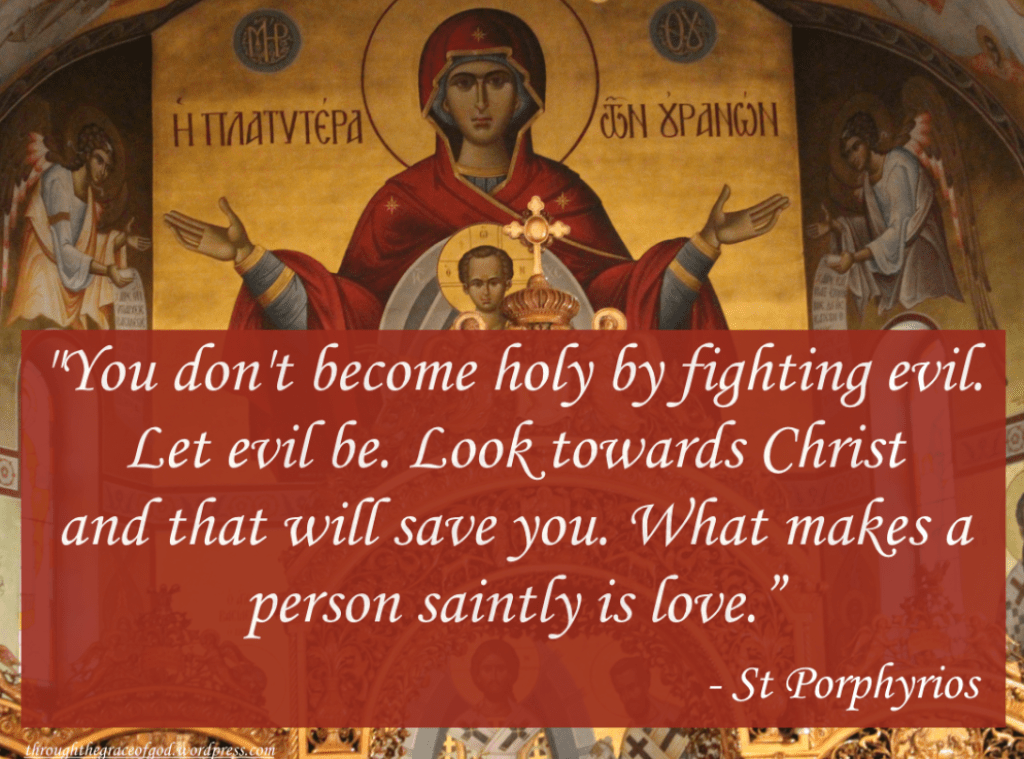
My dears coming to Church every Sunday but living with the mindset that we are better, that we must fight against evil, we must save the world, is the same as never coming to Church because in both cases we’ve missed the message. “For God so loved the world that he gave his only Son, that whoever believes in him should not perish but have eternal life. For God sent the Son into the world, not to condemn the world, but that the world might be saved through him.” (John 3:16-18) My dears, the world does not need us to save it because it is saved through Christ Jesus. As St. Porphyrios teaches, “You don’t become holy by fighting evil. Let evil be. Look towards Christ and that will save you. What makes a person saintly is love.” ~ St. Porphyrios. What God wants and what this world needs is for us to show the rest of the world what God’s love means.

That begins by understanding that we are all in need of God’s love, we are all indeed of forgiveness, healing, hope, love and saving. The person next to you in the pew, the ones watching at home, the ones on vacation, or out golfing, sleeping in, etc. the priest, the deacon, the choir member, the parish council, the elder, the black, white, Asian, educated, poor, rich, depressed, anxious, disabled, young, old, married or widowed, etc. Christ came to save all of us because we all have darkness we face, pain we mask, and lies we tell ourselves to make it through. The only one we can’t lie or cheat is God, who loves us each and calls us by name to go out and love others likewise. We all need Christ Jesus, for salvation is only through Him.

Therefore, we, who have heard his call, who gather here, to preach, pray, gather in fellowship, we, are called to be examples of God’s love to the rest of the world. Do we wish for others to come back also? Of course. Do we pray for our Churches to be full? Of course. But that is the choice of each person, to carry or abandon their cross, to answer or ignore God’s love. However, when we have answered and we believe that we are carrying our cross, then we have a responsibility to illuminate and share the God’s light through love. So that when the world sees us and that love, the world will realize salvation comes only from God. Pray for one another, forgive to be forgiven, love one another even if others don’t love back. That is what is commanded of us and that is why Christ died for us – to save us from darkness and bring us back to his light. Therefore, let us be the light that will bring others back to Him, Amen!

You Can’t Have One Without the Other

Passages: Isaiah 5:1-10; 1 Corinth. 6:18-7:11; Matt. 19:3-12
Ընթերցումներ՝ Եսայու Ե 1-10; Ա Կորնթ Զ 18 – Է.11; Մատթ. ԺԹ 3-12

In the name of the Father, Son and Holy Spirit, Amen!

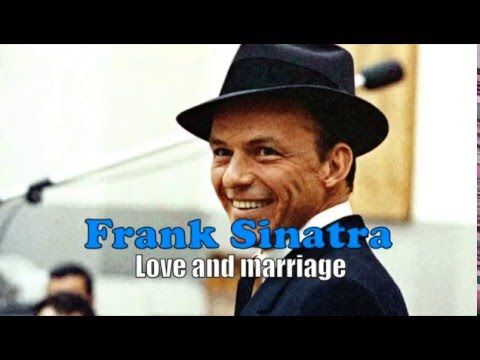
“Love and Marriage, love and marriage, go together like a horse and carriage. This I tell you brother, you can’t have one without the other.” These 1955 famous lyrics written by Jimmy Van Heusen and popularized by Frank Sinatra speak about the beautiful inseparable union of love and marriage. The union of a husband and wife only possible through the love they share with each other. As Christian’s, we understand this love to be self-sacrificing, hopeful, patient and enduring, all the qualities of not just

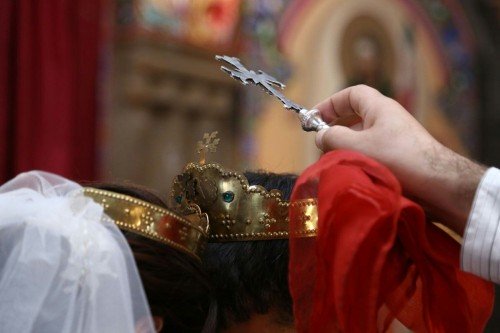
husband and wife but of all the saints of the Holy Church. That is why in Armenian, the sacrament of marriage is known as Soorp Bsag or Holy Crowning, referring to the crowns of our saintly martyrs. This crowning of the martyrs does not speak about physical crowns nor the pomp and circumstance of the wedding service. Rather, just as martyrs receive their crown of glory from God, likewise, a newly married couple receives their crowns from God, as the prayer of marriage say, “And now, O Beneficent Lord our God, as you did bless the marriage of our holy ancestors…bless likewise, this marriage…who you have honored with the Holy Crown of Matrimony.” (Prayer of Crowning, Sacrament of Holy Crowning)

This divine union of man and wife is a gift given by God and nothing must divide that union, as scripture teaches us, “…he who made them from the beginning made them male and female,and said, ‘For this reason a man shall leave his father and mother and be joined to his wife, and the two shall become one flesh’? So, they are no longer two but one flesh. What therefore God has joined together, let not man put asunder.” (vv. 4-6) St. Paul additionally teaches us in today’s reading that as husband and wife, there is a duty to each other to tend, love, and share a deep intimacy that goes beyond the physical relationship. However, my message today my dears, is not a wedding sermon, nor is the Gospel reading today only about a physical or sacramental marriage because not all of us will get married and in the sinful world we live in, not all marriages, even through the Church, remain unbroken. For we all know divorce today is rampant. Yet, scripture speaks to all of us, young and old, even to those who are not married.

The scriptural image of marriage, this union which Christ Jesus teaches us that God the Father has ordained from the very beginning, even the sacramental marriage service of man and woman in the Church are all examples of our communion, our intimacy, our love and marriage to God. Many of us may not see or understand how our communion with God is the same as a marriage union. This may be because today, for many of us, marriage is merely a service we do out of tradition or obligation, a contract between a man and a woman. Or we see it has a failing institution rather than what it is mean to be, what God created it to be – an example of something deeper.

Every Sunday, after the Gospel reading, what do we recite? The Havadamk, the Nicene Creed. And in the Havadamk what do we say about Christ Jesus? “[We believe] in One Lord Jesus Christ, the Son of God… who for us men and our salvation came down from Heaven, took body, was made man and was born…” Meaning, God the Son, emptied himself, lowered himself and took on our form, took physical form in order to suffer, to thirst, to hunger and to feel our joy and pain. (Phil. 2:7) Christ Jesus came to die for us, and to raise us up with Him. This is the fundamental belief of the Christian faith rooted in the love of God for creation. This is also the fundamental reality and the root of true love between a husband and wife. For each to feel each other’s pain and to lift each other up; to wipe the tear the other cries; to celebrate the joy and carry the burdens of life. That is what divine love is and this divine love is what our communion with God is, whether we are physically married or not.

We, as the members of the body of Christ, are the bride, the love of God and for us, Christ Jesus died. Regardless of the pains we feel, the darkness we are surrounded with, the regrets we have, the loss, the sickness, or burdens we carry; regardless of our age, our gender, our skin color, our job title, God’s self-sacrificing love brings us up, lifts us up, wipes our tears and heals us. However, just as a husband and wife must be open to each other, likewise, we must fully open ourselves up to God, come to the Holy Altar and confess our need for healing and our need for God. No matter how fallen we may think we are, God’s love is greater; No matter how far we feel we have fallen, God’s love reaches deeper; No matter where we go in life, God’s love remains because we are His and His love endures forever.

A love that brings all of us into communion with Him. It is this Holy Communion, that God ordained from the beginning, when He created humanity in His Divine image. It is that Holy Communion which we share in when we consume the body and blood of Christ Jesus: “‘Truly, truly, I say to you, unless you eat the flesh of the Son of man and drink his blood, you have no life in you; he who eats my flesh and drinks my blood has eternal life, and I will raise him up at the last day. For my flesh is food indeed, and my blood is drink indeed. He who eats my flesh and drinks my blood abides in me, and I in him.’” (John 6:53-56) Therefore, what God has joined, let no one separate.

My dears, today we see marriage failing, we see families falling apart, communities, neighborhoods, cities, countries killing each other and destroying one another physically, emotionally, mentally and especially spiritually. However, it all starts here at the Holy Altar and continues with us. If we do not learn what God’s love for us is, and then take that love outside these doors to our homes, to our workplace, our leisure, etc. then we will create a loveless and broken world. If we are not in communion with God, then we have divided that which God has brought together. Let us therefore, come to God in our brokenness, in our curiosity, humbled and hopeful that His Divine love and our Holy Communion will only grow stronger, in the same way the love of a husband and wife grows stronger over time with care and patience. For if the words of Frank Sinatra say love and marriage are inseparable, God’s love for us is far more indivisible and immovable. “…neither death, nor life, nor angels, nor principalities, nor things present, nor things to come, nor powers, nor height, nor depth, nor anything else in all creation, will be able to separate us from the love of God in Christ Jesus our Lord.” (Romans 8:38-39 RSV) Love and marriage, us and God, go together like a horse and carriage. This I tell you brother, we can’t have love without our heavenly Father, no you can’t have one without the other. Amen!

God Shed His Grace Through Thee

Passages: Isaiah 3:1-11; Romans 11:13-24; Matthew 14:13-21
Եսայու Գ 1-11; Հռոմ. ԺԱ 13-24; Մատթ. ԺԴ 13-21

In the name of the Father, Son and Holy Spirit, Amen!

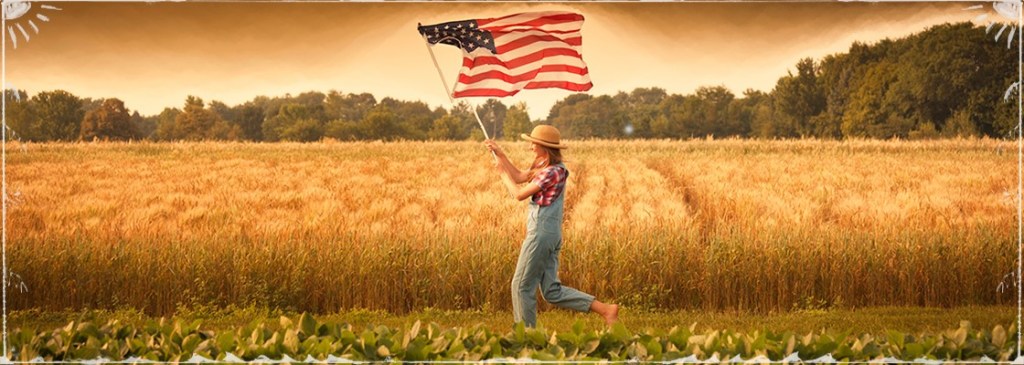
Happy Independence Day dearly beloved brother and sisters! Happy and blessed day of remembrance of the freedom we enjoy because of the sacrifices made by men and women, political and religious leaders, father’s, mother’s, sons and daughters; individuals who paved the

way for these United States to be the place we each call home. Whether or not we agree with its current governance, or whether we accept the history and trajectory for the future, whether we were born here or arrived here under different circumstance, today, we gather and make our homes in this country. Yet, how can the 4th of July and all that we celebrate today with fireworks, hot dogs and burgers impact and influence our faith?

On this day we give thanks that we live in a country that, for better or worse, allows freedom, gives opportunity, and allows us to be who we want to be. Therefore, today is a celebration of liberty and freedom or as the Declaration of Independence states, “life, liberty and the pursuit of happiness”. However, life, liberty, and eternal happiness for us Christian’s comes not from a document, or through our own ideas because ideas can change, and documents can be altered. Rather, true life, liberty, and happiness for us who call upon God, comes only from God our Father, the Son and Holy Spirit. A God that does not change or go with the times; a God that has given each of us a new life and freedom from sin; a God that came to us and now we must look to Him, for it is through Him we have been liberated. Does this mean we cannot pursue our dreams and aspirations? Of course we can. Does this mean that if we are patriotic, that we are in some way at odds to what God teaches us? No it does not. What it means is that we qualify the value of our life, liberty and happiness on the understanding that it is God who created that life, it is God who sets us free, and it is God who blesses us with joy. But how?

In the 1904 version of the song, “America the Beautiful” written by Kathrine Lee Bates, the lyrics after each verse speak to God directly:

O beautiful for spacious skies,
For amber waves of grain,
For purple mountain majesties
Above the fruited plain!…

America! America!
God mend thine ev’ry flaw,
Confirm thy soul in self-control,
Thy liberty in law.

America! America!
May God thy gold refine
Till all success be nobleness,
And every gain divine.

America! America!
God shed His grace on thee,
And crown thy good with brotherhood
From sea to shining sea.

These words, which are directed to God are not mere lyrics but a prayer. A prayer from each one of us who calls this country home and who wishes to enjoy its blessings. Each stanza asks for God to come and bless us and bless those around us. Each a confession for His divine love, presence and freedom in our life. Now look at the words of today’s Gospel, “When it was evening, the disciples came to him and said, ‘This is a lonely place, and the day is now over; send the crowds away to go into the villages and buy food for themselves.’ Jesus said, ‘They need not go away; you give them something to eat.’”

My dears, God works through us to bless this world. God uses our hands, feet, mouth, eyes and ears, to build up and shed His grace on us by feeding the hungry and clothing the naked. God guides us to bring into fruition His divine plan in this world, whether it is in the United States, in Armenia, in our communities, or in our homes. Therefore, for us Christian’s, who confess that Christ Jesus our Lord, came and died on the cross, rose from the dead and gives us life and liberty, we cannot ignore the truth that our true pursuit of happiness is rooted in our expression of love and happiness in each other, to feed each other. For all of God’s commandants can be summed up how? Love the Lord God with all your heart, soul and mind, and love your neighbor as yourself. It was this love of our neighbor that the forefathers of the United States had in their heart when the signed the declaration of Independence. No, not all of them agreed and no they were not perfect however, their trust in God allowed for them to form this nation. A nation in which we have life; a nation in which we are free; a nation in which we can also give life to others through our faith in God. Therefore, ask how does life, liberty and our pursuit of happiness treat the person next to us, our selves, our neighbor? Do we send them away, or do we feed them? Do we ignore, gossip, lie and cheat each other, or do we build each other up? My dear brothers and sisters, whether we celebrate the Independence Day of the United States, of Armenia, of Canada or whatever country we call home, if we do so with the knowledge that true life and liberty come only from our Lord then our home will be blessed for we, as children of God, will bless each other.

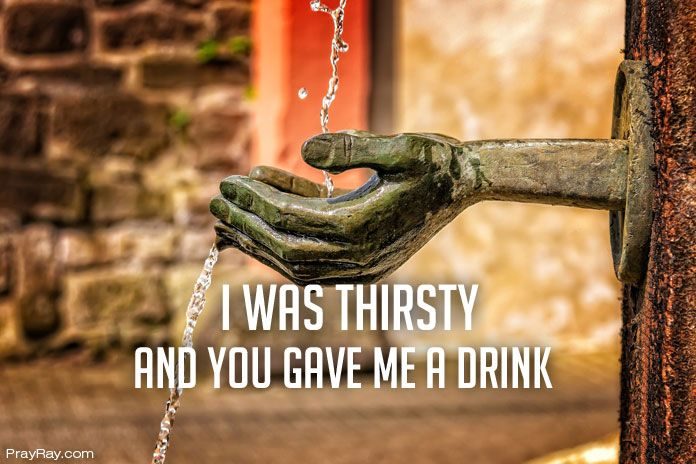
Love one another, pray for those who you do not agree with, feed the hungry and clothe the naked – “For I was hungry and you gave me nothing to eat, I was thirsty and you gave me nothing to drink, I was a stranger and you did not invite me in, I needed clothes and you did not clothe me, I was sick and in prison and you did not look after me.’ ‘They also will answer, ‘Lord, when did we see you hungry or thirsty or a stranger or needing clothes or sick or in prison, and did not help you?’ ‘He will reply, ‘Truly I tell you, whatever you did not do for one of the least of these, you did not do for me.’” (Matt. 25:42-45) Happy Independence Day, my dears and may “God shed His grace on thee, and crown thy good with brotherhood from sea to shining sea.” May God shed His through me. Glory to God Amen!